



Articles
Construction of Residential Buildings

Historically, housing has played a significant role in people's lives, serving as their permanent residence and ensuring the fulfillment of various tasks. In ancient and medieval times, for the common people with minimal comfort, the primary purpose was safety: "my home is my fortress." Later, for the higher classes, housing took on palace-like forms, symbolizing the status, grandeur, and wealth of the owners.
As human civilization evolved, residential buildings underwent changes, acquiring new forms and meanings.
As human civilization evolved, residential buildings underwent changes, acquiring new forms and meanings.
In the modern world, housing continues to play a crucial role in the life of civilized individuals, satisfying several fundamental requirements—safety and reliability, comfort and harmony, ecology, and cost-effectiveness.
In our country, the "housing issue" has always been and remains acute, with demand for square meters remaining unmet. The view is unsatisfactory, despite not questioning the historical expediency of post-war residential development in Ukrainian cities, mostly represented by "Khrushchyovkas," "Stalinkas," and "Brezhnevkas."
Nevertheless, life, as we know, does not stand still, and for many, the trend of renewal has become evident, either by copying Western modern architectural patterns or by deviating from the numerous shades of the gray Soviet period.
MOST POPULAR HOUSING CONSTRUCTION TECHNOLOGIES IN UKRAINE
Monolithic Frame Technology
Currently, in the Ukrainian construction market, especially in large cities, this technology is dynamically developing and widely used in the construction of multi-story residential buildings. The sequence of actions is simple and logical. The reinforcement frame is assembled, then enclosed in the formwork panels. Concrete mix is delivered to the site by special vehicles—concrete mixers—and poured into the space between the formwork elements. After gaining the necessary strength—solidification of the monolithic frame—the formwork is dismantled and reinstalled for new structural elements.
Currently, in the Ukrainian construction market, especially in large cities, this technology is dynamically developing and widely used in the construction of multi-story residential buildings. The sequence of actions is simple and logical. The reinforcement frame is assembled, then enclosed in the formwork panels. Concrete mix is delivered to the site by special vehicles—concrete mixers—and poured into the space between the formwork elements. After gaining the necessary strength—solidification of the monolithic frame—the formwork is dismantled and reinstalled for new structural elements.
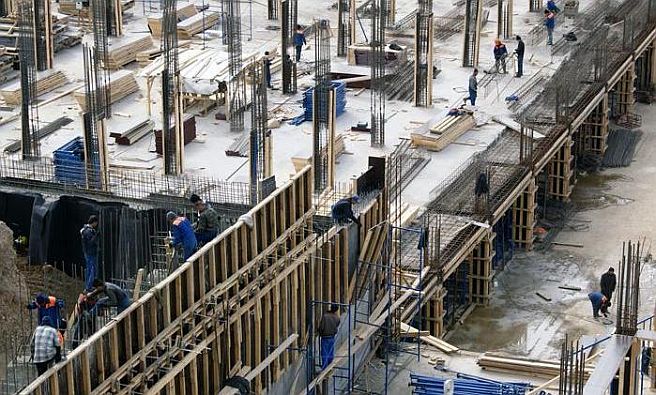
Thanks to the use of this technology and effective process management, similar to a conveyor in large-scale construction, it has been possible to significantly reduce the construction period and reduce the cost estimate. Monolithic buildings also have good indicators of thermal insulation and soundproofing.
Over the past twenty years, monolithic frame construction in Ukraine seems to be experiencing a renaissance. Previously, during the Soviet industrialization, this technology was tested in the construction of residential and industrial facilities. However, the scale of construction at that time could not provide conditions for its development. Ukrainians chose brick residential buildings, and later, under the auspices of the state, the market was conquered by panel (or assembled) residential construction.
Modern interest in monolithic frame technology in the construction of multi-story buildings, as well as the advantages for professionals and residents compared to panel building technology, is positively evaluated based on the following criteria:
- reduction of operating costs;
- reduction in metal consumption;
- reduction of expenses for strengthening the material and technical base.
Evaluating the prospect of technology development, one should consider the positive experience of monolithic construction in developed countries: in the United States and European Union countries, the ratio of buildings constructed using this technology to the total construction volume ranges from 60 to 80 percent. In Ukraine, this indicator is several times lower, indicating a high potential for the application of monolithic frame construction technology in the next decade.
Monolithic Frame Technology is also used in the low-rise segment, with a positive trend of gradually displacing the "classics." However, at present, traditional low-rise brick houses, which this technology allows to build up to nine floors, are more popular among Ukrainians despite a longer construction period.
Alternative solutions that allow private developers to build low-rise houses, achieving significant construction cost savings, shortened terms, and reduced operating costs include: permanent formwork; removable modular formwork; frame house building; 3D panels.
Permanent Formwork
Lighter materials than concrete are used as formwork blocks (or panels). The space between the blocks is reinforced and filled with a concrete mix, which, when solidified, rigidly fastens the structure. The blocks, as elements of permanent formwork, remain in the building frame, serving as thermal insulation. Recently in Ukraine, permanent formwork made of pressed coniferous wood chips (Velox) and polystyrene blocks (Thermodeem) has gained popularity.
Lighter materials than concrete are used as formwork blocks (or panels). The space between the blocks is reinforced and filled with a concrete mix, which, when solidified, rigidly fastens the structure. The blocks, as elements of permanent formwork, remain in the building frame, serving as thermal insulation. Recently in Ukraine, permanent formwork made of pressed coniferous wood chips (Velox) and polystyrene blocks (Thermodeem) has gained popularity.
Removable Modular Formwork
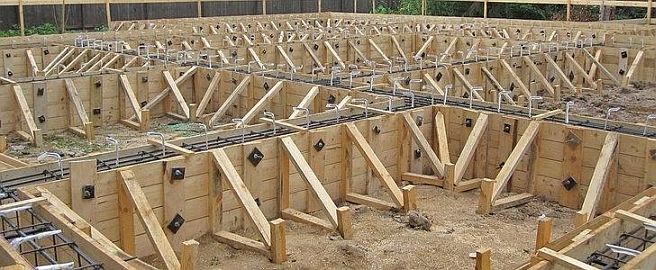
Walls of buildings are assembled on the construction site from modules—hollow blocks—between which a concrete mix is poured. After the mixture hardens, the formwork is dismantled, cleaned, and installed for pouring the next elements of the building structure. This straightforward, economical technology has found its application in individual construction for the following reasons:
- No need for highly skilled labor;
- Construction can be carried out without the use of expensive specialized equipment;
- Concrete mix is prepared directly on the site in small but sufficient quantities.
Frame House Construction
This technology is mainly used in the construction of low-rise apartment buildings, commercial facilities, and public buildings. The frame is made of metal or wood, and the walls on both sides are sheathed with various types of moisture-resistant panels. The space between the panels is filled with thermal insulation and moisture-resistant material. External walls are often "decorated" with plaster or siding, while sheets of drywall are used for interior finishing.
This technology is mainly used in the construction of low-rise apartment buildings, commercial facilities, and public buildings. The frame is made of metal or wood, and the walls on both sides are sheathed with various types of moisture-resistant panels. The space between the panels is filled with thermal insulation and moisture-resistant material. External walls are often "decorated" with plaster or siding, while sheets of drywall are used for interior finishing.
The so-called Canadian technology has become widespread in Ukraine, which involves construction using SIP panels—two OSB boards with a block of polystyrene between them—thus reducing the fire hazard of the building.
One of the well-known Ukrainian companies successfully used SIP panels for the construction of residential buildings—3- and 4-story apartment buildings for military families, fulfilling orders from the State Border Guard Service of Ukraine. As practice has shown, it takes three months to build such a house. They turned out to be warmer and cheaper than brick or panel analogs and less fire-prone than wooden ones.
3D Panels
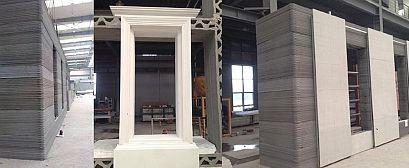
The technology of building houses using 3D panels was invented in the USA, later became widespread in European countries, and is now actively conquering the markets of Russia, Kazakhstan, and Ukraine. Essentially, it is a combination—a symbiosis—of monolithic frame and panel construction options.
3D panels consist of a structure of reinforcing mesh and rods made of high-quality steel, inside which a plate of polystyrene is fixed, covered on both sides with a concrete mix. The concrete mix is applied by shotcreting, covering previously installed engineering communications, and after solidifying, it creates a rigid monolithic frame. According to experts, the technology using 3D panels can be adapted to any architectural project and has several advantages:
- low operating costs;
- easily adaptable for "passive houses";
- high level of thermal insulation;
- short construction periods and low construction costs.
Universal construction group "Novу Zodchу" has acquired extensive experience in the construction of residential buildings using all the technologies presented in Ukraine and mentioned in this article.
At the same time, based on the development trends of the construction market in Kyiv, the board of directors of the "Novу Zodchу" group of companies made a strategic decision to predominantly develop monolithic frame technology. To achieve this goal, a structural unit of specialists and qualified workers was formed and equipped with a material and technical base. In 2016, by the order of the Head of the State Architectural and Construction Inspection, the "Novу Zodchу" company was issued a license, which gives the right to build objects of the highest complexity category.
Our experience in the construction of residential buildings using monolithic frame technology is reflected on the corporate website -
www.n-zodchie.com.
*Attention!
This article is the intellectual property of the "Novу Zodchу" group of companies and is protected by copyright law. When copying the article in whole or in part, attribution, as well as an active (dofollow) hyperlink to the source is mandatory!
This article is the intellectual property of the "Novу Zodchу" group of companies and is protected by copyright law. When copying the article in whole or in part, attribution, as well as an active (dofollow) hyperlink to the source is mandatory!